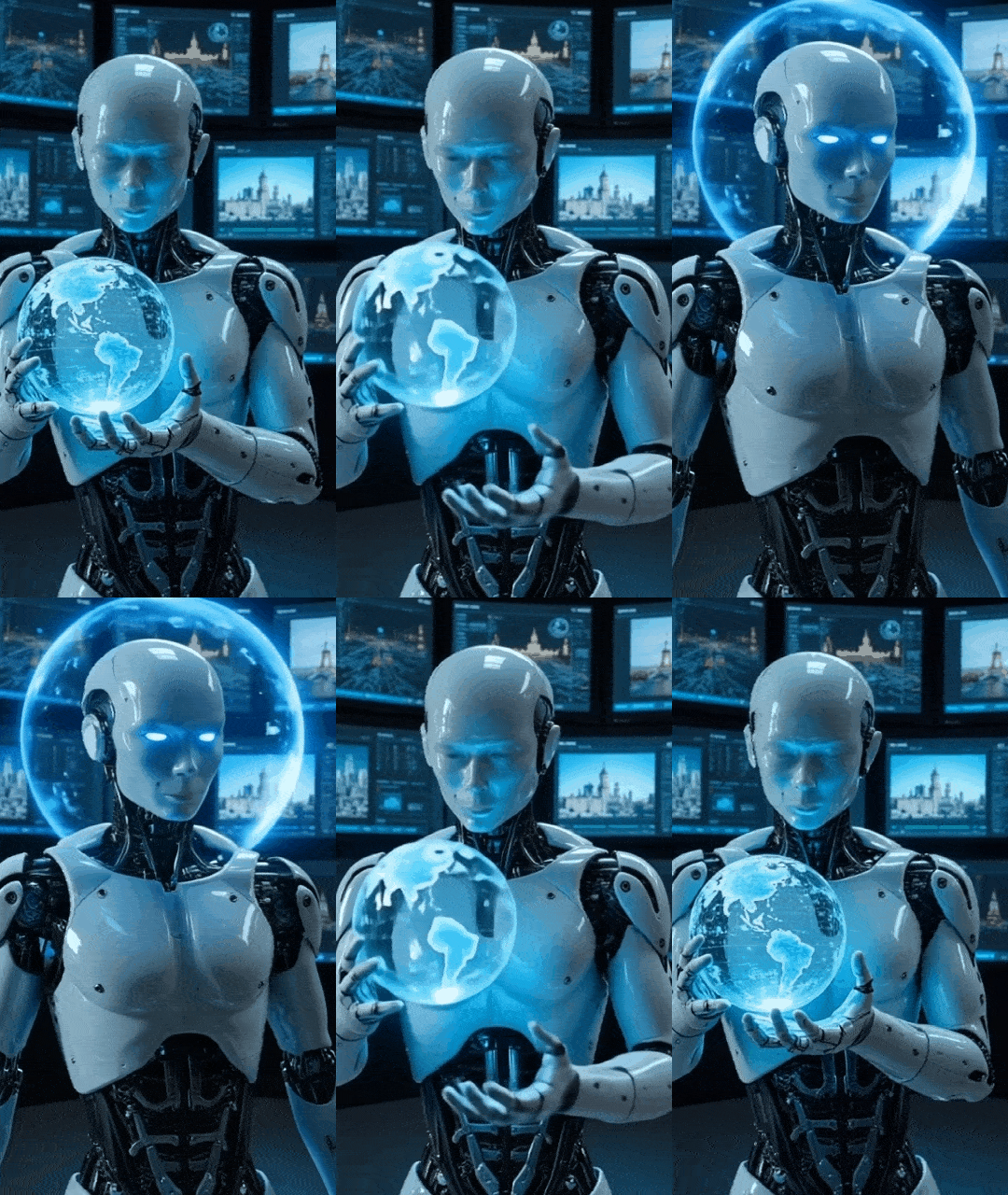
The rise of AI and fall of humans
Date: March 30, 2025 Written By: Ki Lov3 Editor: Toni Gelardi
Sounds like the next movie involving Skynet or the movie where a little kid tells you the key to bending the spoon is realizing there is no spoon. However, this is real life –and humans caused it. Art imitating life or Life imitating art– well, it’s not the time for this philosophical debate.
In a chilling vision of the future, Microsoft co-founder Bill Gates predicts that artificial intelligence (AI) will replace doctors, teachers, and countless other professionals within the next 10 years.
Speaking on The Tonight Show with Jimmy Fallon, Gates warned that AI will soon make human input “unnecessary for most things,” ushering in a reality where machines dominate some of the most sacred pillars of our society: education, medicine, and eventually, the entire labor market. Though framed as a path to global equality and efficiency, this coming wave threatens to fracture economies, devalue human labor, and eliminate the sense of purpose and dignity that comes from work.
While some hail AI as a savior, the data increasingly paints a dystopian future. AI in Healthcare for Diagnosis and Treatment AI has already infiltrated hospitals and clinics—an invisible hand silently replacing the need for human expertise. Tools for Diagnosis AI systems like Google’s DeepMind, IBM’s Watson Health, and PathAI now diagnose diseases including cancer, heart conditions, and eye diseases, often faster and more accurately than physicians.
A study published in Nature Medicine (2019) showed that an AI model diagnosed lung cancer from CT scans with 94.4% accuracy, outperforming six expert radiologists. Another AI system diagnosed diabetic eye disease in under a minute — a task that could take an ophthalmologist 10–15 minutes.
Analysis of Medical ImagesAI platforms like Zebra Medical Vision and Aidoc scan thousands of radiological images in seconds, detecting strokes, tumors, and fractures with unmatched speed.These systems don’t get tired, don’t make judgment errors under pressure, and never ask for a vacation — making them a dream for hospital CEOs, and a nightmare for human doctors.

AI Tutors and Personalized Learning in Schools Customized Learning. AI tools like Khanmigo (Khan Academy’s GPT-powered tutor), Duolingo, and Socratic by Google deliver on-demand, hyper-personalized education. They learn students’ weaknesses, adapt in real-time, and never get bored explaining the same concept again and again.A 2021 Brookings Institution study confirmed that AI-assisted tutoring can significantly increase academic performance, especially in underserved communities.
How to Learn a Language.
Language-learning apps now use AI to evaluate pronunciation, detect grammar mistakes, and even carry on realistic conversations. Tools like Duolingo’s GPT-4 based bots have replaced human tutors for millions of users.
But what does it mean when machines replace teachers — not just in classrooms, but in the hearts of young learners?
The Dark Side: Effects on the Economy and Society Despite its promise, the rise of AI is accelerating a future of joblessness, economic instability, and social decay.
Loss of Jobs and Trouble in the Economy A 2023 report from Goldman Sachs estimates that AI could replace 300 million full-time jobs globally. Clerical and administrative workers, legal assistants, paralegals, customer service reps, and even journalists are already seeing AI automate once-secure roles.
According to the World Economic Forum, 85 million jobs will be displaced by 2025, with only 97 million new roles created — many of which require specialized skills the displaced workforce may not have access to.
Impacts on Workforce Training Historically, young professionals acquired experience by commencing in entry-level positions – analyzing case files, composing notes, and evaluating reports Currently, AI performs this menial task instantaneously.
How will future generations attain expertise without basic training?
In medical, law, and finance, junior personnel were previously educated through practical, repetitive activities.
Currently, AI undertakes these activities, undermining the fundamental components of human skill acquisition.Jobs for creative people:
Creativity is one of the few things that humans still do well, but even that is in danger.
Tools like MidJourney and ChatGPT can now write poetry, make art, and make music. They don’t have much emotional depth, but they’re already common in creative fields..
What Emotional Intelligence Does Therapists, caregivers, and social workers rely on empathy and intuition — qualities AI has yet to replicate convincingly.
But as bots get better at mimicking emotional response, even these fields may not be safe forever. Leadership for Strategy While AI can analyze data and suggest solutions, strategic leadership still requires intuition, ethical reasoning, and decision-making in uncertain situations — skills not easily programmed.How to Get Around the AI Revolution New Skills and Education Survival in the AI era demands retooling the workforce.
Skills in cybersecurity, ethical AI development, emotional labor, and system design may offer a lifeboat — but training must be accessible and massive in scale.
Rules and Policies Governments must move fast. Legislation is needed to: Regulate AI use in hiring and healthcare .
Set limits on surveillance Prevent monopolistic control of AI infrastructure Failure to act could result in a society where wealth and power are concentrated in the hands of a few tech giants.
Humans and AI Working Together. There’s hope for collaboration — if managed responsibly. Human-AI hybrid models, where machines handle data and humans provide context and meaning, may preserve jobs while boosting productivity.
Conclusion: The Age of “Free Intelligence” or Forced Irrelevance?
Bill Gates may call it “free intelligence,” but many fear what happens when work, purpose, and human skill are deemed obsolete. As AI threatens to outthink and outperform us, we’re left with urgent questions:
What does it mean to be human when machines can do almost everything?
Can a society function where most citizens are economically irrelevant?
And who will decide how this technology is used — and who it benefits?
The AI revolution isn’t coming — it’s already here. The time to confront it is now, before we wake up in a world where humans are no longer essential.
Sources:
GatesNotes
BlogStanford University Center for AI SafetyNature Medicine
JournalBrookings Institution Report on AI and EducationGoldman Sachs AI Economic Report (2023)The Coming Wave by Mustafa Suleyman
 Ki Lov3 | Best Selling Author - Toni Gelardi - Chief Editor - Ki Lov3 Books etc